
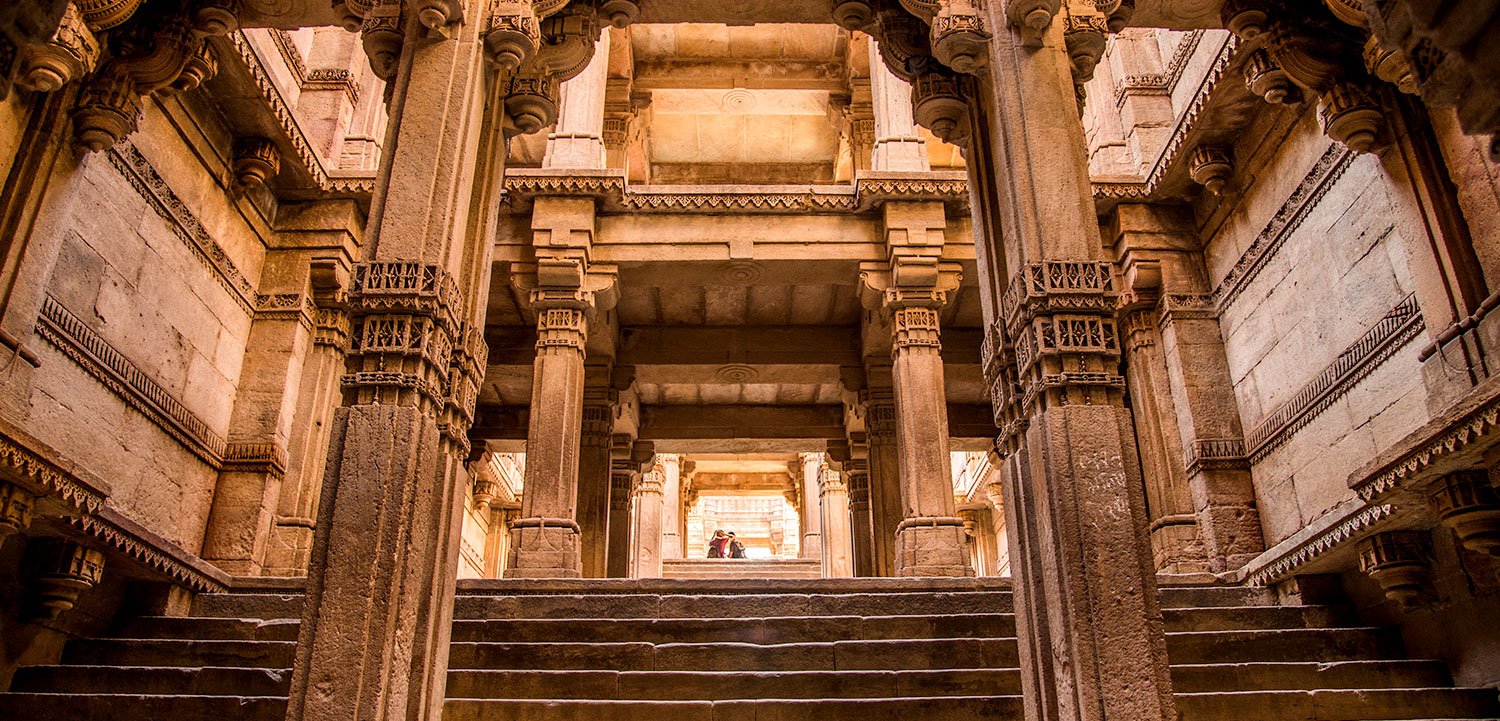
The subterranean architecture of western India represents an extraordinary synthesis of utilitarian engineering, hydrological science, and sacred art. Among the subterranean monuments dotting the semi-arid landscape of Gujarat, the vavs, or stepwells, stand out as monuments where the sacred and the mundane converge. Located just outside the state capital, the ancient site known as the Adalaj Stepwell offers a masterclass in Solanki-style architecture combined with early Indo-Islamic craftsmanship. Commissioned in 1499 by Queen Rudabai, the consort of the Vaghela chieftain Rana Veer Singh, and completed under the patronage of the Muslim Sultan Mahmud Begada, the monument serves as an enduring testament to architectural syncretism. Deciphering the intricate friezes, pillars, and relief panels reveals the narrative complexity embedded within its five subterranean stories.
Historical Context and Architectural Synthesis
The construction of the stepwell unfolded during an era of significant political transition across western India. When Sultan Mahmud Begada conquered the region, work on the reservoir was already underway under local Hindu auspices. Rather than halting the work, the Sultan sanctioned its continuation, allowing local artisans, known historically as the Salats, to retain their artistic lexicon while incorporating Islamic sensibilities.
This collaboration yielded an architectural marvel where floral ornamentation and geometric symmetry interlace seamlessly with traditional anthropomorphic imagery. The structure itself descends through five distinct levels, each tier anchored by an array of intricately carved sandstone pillars that diffuse daylight while sustaining structural integrity. As one journeys downward from the hot surface into the subterranean microclimate, the carved imagery transitions from broad architectural bands to finely rendered thematic reliefs, each narrating tales of devotion, nature, and community life.
The Sacred Iconography of Water and Fertility
Water holds a preeminent place in Indian iconography, representing purity, life-giving power, and the primordial cosmic ocean. The reliefs across the upper and middle tiers of the stepwell repeatedly honor this sacred connection.
- The Kalpavriksha (Tree of Life): Intricately carved stone screens depict stylized branches and lush foliage, symbolizing abundance, continuity, and divine shelter.
- The Purna Kumbha (Overflowing Pot): Positioned along pillar bases and wall niches, the vessel brimming with water and foliage signifies spiritual prosperity, purification, and the ceaseless renewal of life.
- Ami Khumb (Vessel of Nectar): Carved into central friezes, these motifs evoke the nectar of immortality, symbolically sanctifying the water stored deep within the subterranean well shafts.
In addition to these abstract motifs, several relief panels portray Hindu deities closely associated with cosmic balance and preservation. Depictions of the Navagrahas (nine celestial bodies) were embedded within lower retaining niches to ward off cosmic misfortune and protect those descending the flights of steps. Small shrines recessed into the sandstone blocks honor the divine feminine, specifically representations of the goddess Bhadrakali, reinforcing the role of the reservoir as a pilgrimage sanctum where women gathered to draw water and offer daily prayers.
Secular Scenes and Daily Life in Fifteenth-Century Gujarat
While sacred symbolism abounds, a substantial portion of the stone reliefs at the monument captures the vibrant social fabric of medieval Gujarat. Unlike surface temples, which were largely reserved for formal worship, stepwells were active civic and communal spaces. Women gathered on the landings during the sweltering afternoons to rest, trade stories, and draw cool water.
The artisans faithfully preserved this everyday life in stone. Intricate panels along the secondary corridors feature women churning buttermilk with rhythmic gestures, their garments rendered with meticulous geometric patterns mirroring traditional Gujarati textiles. Nearby friezes portray maidens adorning themselves with traditional jewelry, styling their hair before stone mirrors, and conversing in small groups.
Other dynamic reliefs celebrate celebration and majesty. Processions of caparisoned elephants, royal horses with ornate bridles, and lively retinues of court musicians playing drums, flutes, and cymbals encircle the lintels. These friezes not only immortalize the prestige of the ruling dynasty but also establish a visual chronicle of the festive gatherings, royal travels, and domestic routines of the late fifteenth century.
Indo-Islamic Geometric Harmony and Floral Abstraction
The visual brilliance of the monument lies equally in its delicate balance between figurative sculpture and abstract geometric design. As the eye moves toward the upper registers and ceiling domes, the presence of Islamic decorative aesthetics becomes striking.
Interlocking arabesques, multi-petaled rosettes, stylized lotus buds, and repeating geometric grids dominate the friezes of the intermediate galleries. Unlike contemporary Sultanate architecture elsewhere, which avoided anthropomorphic representation entirely, the artisans here wove geometric perfection directly alongside figurative panels. The octagonal openings, through which gentle sunlight filters into the subterranean galleries, showcase stone lattices (jalis) carved with such precision that the heavy sandstone appears weightless. This structural and visual dialogue between Hindu iconography and Islamic ornamentation creates a cohesive spatial harmony rarely matched in medieval architectural history.
Preserving Heritage for Modern Exploration
Today, the stepwell remains a vital cultural anchor for Gujarat, drawing historians, architects, and travelers who wish to understand the region’s historical mastery of water harvesting. For modern visitors exploring the capital city, pairing a study of historical engineering with contemporary regional hospitality completes the journey. Discerning travelers staying at the best hotel in Gandhinagar can easily access this fifteenth-century wonder, making it possible to retreat from modern urban life into the cool, silent chambers of medieval history. Every pillar, lintel, and niche within the stepwell continues to narrate an unbroken story of devotion, civic unity, and artistic brilliance that has defied the passage of centuries.