
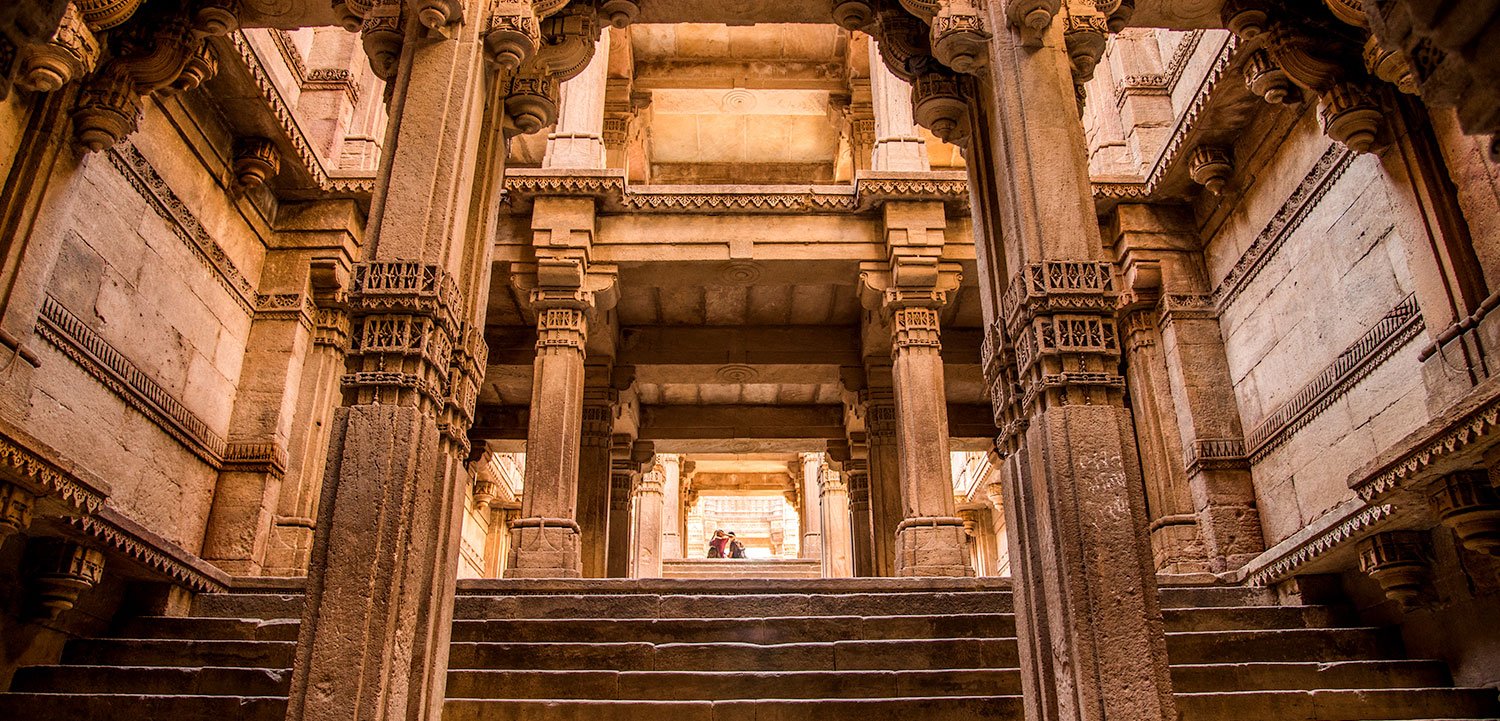
Ahmedabad is a city where history seamlessly interfaces with modern infrastructure. While contemporary travelers often look for the best 5 star hotel in Ahmedabad to experience premium hospitality, the true architectural anchor of the region lies just a short drive away. The Adalaj Stepwell, or Adalaj ni Vav, built in 1498 by Queen Rudabai, stands as a masterclass in ancient Indian civil engineering, hydrology, and microclimate management.
At first glance, the structure appears to be an ornate underground palace. However, its primary purpose was strictly functional: to conserve water in a semi-arid landscape and provide a sanctuary for weary traders navigating the historic trade routes. Understanding the brilliance behind this subterranean marvel requires looking past the intricate sandstone carvings and analyzing the mathematical, structural, and thermodynamic principles that have kept it standing for over five centuries.
Subterranean Structural Dynamics and Load Distribution
Building deep into the earth presents entirely different engineering challenges than building upward. The architects of Adalaj had to contend with immense lateral soil pressure pushing inward against the walls, alongside the vertical load of the heavy sandstone structure itself.
To prevent the earth from collapsing inward, the stepwell was designed using a unique multi-tiered, five-story subterranean beam-and-column framework. Each level acts as a massive structural brace. The pillars are precisely spaced to distribute the weight evenly, while heavy horizontal lintels lock the vertical columns into place. As you descend deeper into the stepwell, the columns and beams become noticeably thicker and more robust, demonstrating that the ancient builders explicitly understood how hydrostatic and soil pressures increase with depth. This structural foresight is the primary reason the stepwell has survived major seismic activity in the region, including the devastating 2001 Gujarat earthquake.
The Science of Subterranean Microclimates
One of the most remarkable aspects of Adalaj Stepwell is its ancient air conditioning system. The stepwell is designed as a vertical funnel that completely alters the ambient atmospheric conditions. Even when summer temperatures on the surface exceed 45°C, the lowest levels of the stepwell remain a refreshing 5 to 6 degrees cooler.
This cooling effect is achieved through a combination of structural shading and evaporative cooling. The top of the stepwell features a large opening that allows light and air to enter, but the deep, narrow design ensures that the lower levels never receive direct sunlight. As air flows down the steps, it passes over the water reservoir at the bottom. The heat from the air evaporates a small amount of water, which absorbs the thermal energy and drastically drops the temperature of the surrounding space. The stone walls, shielded from the sun, act as thermal masses, absorbing what little heat remains and keeping the lower galleries comfortably cool for hours.
Precision Hydrology and Silt Filtration
Adalaj Stepwell was not just a static pool; it was connected to the regional water table and designed to collect seasonal monsoon runoff. In a region where rainfall is concentrated into a few intense weeks, managing water flow and preventing contamination was critical.
The stepwell was engineered with a series of stepped collection pools that allowed incoming water to slow down before entering the main well shaft. This reduction in velocity caused heavy silt, sand, and debris to settle at the bottom of the outer pools rather than contaminating the core drinking water supply. The main shaft itself dug deep into the aquifer, ensuring a steady supply of naturally filtered groundwater year-round. This dual-source reliance—monsoon collection combined with groundwater tapping—made Adalaj a highly reliable life-support system for the local community and passing caravans.
Spatial Flow and the Caravan Route
Beyond its hydrological and structural triumphs, the stepwell is a triumph of spatial planning. The structure features three distinct entrance points that converge into a single underground path. This layout was intentional, allowing large numbers of people to access the water without causing dangerous bottlenecks on the steps.
For traders moving goods across Western India, these stepwells were the gas stations of antiquity. A merchant traveling from the coastal ports of Gujarat toward inland trading hubs would map their journey entirely around these water structures. Interestingly, these routes connected diverse regional hubs; a merchant might rest at Adalaj before continuing inland toward Rajasthan, eventually seeking out a comfortable business hotel in udaipur to conclude their trade agreements. The architectural layout of Adalaj accommodated this high volume of foot traffic by providing wide galleries and ledges where travelers could rest, sleep, and socialize out of the blistering sun while their animals rested at the surface troughs.
Architectural Legacy of Western India
The Adalaj Stepwell remains an enduring testament to the fact that ancient Indian architecture never separated utility from artistry. The columns are adorned with intricate carvings depicting everything from mythological scenes to daily life, all carved into the same sandstone that provides the structural integrity of the well. By burying the architecture underground, the builders protected the stone from the harsh weathering effects of wind and direct sunlight, preserving the sharp details of the craftsmanship for hundreds of years. It stands as a profound reminder that true engineering brilliance does not fight against the natural environment; it works in absolute harmony with it.